As in all media, religion is very evident in film. As I was looking into the different types of religions mentioned, the main theme I kept coming across was the idea of an angel. The term angel is most often associated with some kind of messenger or helper sent from God, so I thought I would look a little deeper to see if this was true in films.
When I first looked into this idea of an angel, the immediate movies that came to mind were Christmas movies. As our book discussed, the seemingly acceptable form of religion in media comes at Christmas time. “It’s a Wonderful Life” is a prime example where the entire movie centers around an angel, Clarence, who helps George Bailey realize how important his life is.
Moving on from the Christmas genre, Angels have become more evident in other major motion pictures. In 1994 the film “Angels in the Outfield”, a young boy’s father tells him they will be a family again when the California Angels win the pennant, so the boy prays for divine help. The answer to his prayer comes in the form of a group of angles who help the team toward their winning. Though this movie is created for a younger audience, it has a powerful message about prayer and divine help.
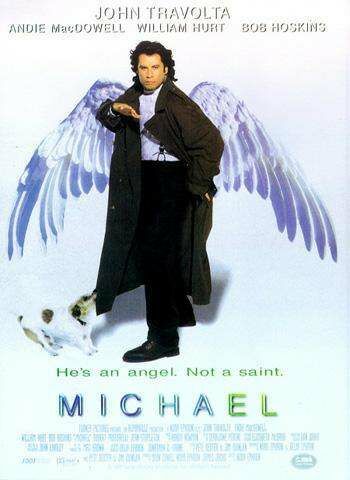
There are also movies that are created for an older audience such as “Michael” and “City of Angels”. In “Michael” a writer comes across a man who is an angel on vacation. Michael claims that he has only a couple “angel vacations” to earth and he is taking his last. During his time on vacation he does everything that is contrary to what people believe angels should do including smoking, drinking and he has poor personal hygiene. Right before Michael has to return to heaven, he performs a miracle that saves the writers life.
“City of Angels” has a similar view of angels in the fact that it shows an angel who falls in love with a woman and is trying to decide whether or not to become human. When he does become human, the woman then dies and he is left alone. He states that he would rather have been alive with her for only a moment than an angel and never had that experience.
“Charlie’s Angels” is another movie title with the mention of angels, but in fact, the movie itself has very little religious affiliation. The word angel has taken a whole new meaning in this movie. The girls in the movie are not religious messengers sent from Heaven, but in fact a group of investigators working for a man named Charlie.
Though it might seem that the concept on an angel is moving to a more secular form than a religious form, I would argue that when an angel is used, it still always carries a religious theme. Even if it is not direct, the concept of an angel still means a messenger sent to save or to help someone. Though it is not always specific as to who has sent the “angel” it still carries a religious underlying message that someone is there to help when you are in need. Though the angels are not always a person dressed in white (i.e. Michael who smokes and drinks), they still end up saving a life or doing something good with a very religious meaning behind it.
Question: Does the use of angels in films still carry a religious meaning, or has it completely moved to a secular theme?
As T.V. viewers many that have some kind of religious background can see trends or examples in their favorite TV shows, that an episode may relate to a spiritual experience between characters. Religion is portrayed in some way in television to kneeling on the ground asking God for help, having a change in heart towards someone and forgiving them allowing them to move forward in life. I think it captures the audiences in relation to the character and the relationship with God. If ninety-five percent of Americans indicate that they believe in some sort of God or Higher Power. It is only plausible that a well familiarized television series will have some kind of spiritual act or experience in the show that the audience can relate to. In the television series Touch By An Angel the shows was based on an actual angel coming into someones life to help them and to show them the way or path that God wants them to be on. The character Roma Downey is sent by God to bless the lives of others and she tells those she meets that God loves them and she was sent to help them with their trail the character is facing, helping them get on track the Lord wants them to be on.
It seems like practically every TV show out there has some affiliate to religion or pop culture and how it is common to pray to God or some kind of higher power to some, for guidance and help. I have seen countless times in many television series that the tough masculine guy when someone is hurt he loves that is when he will ask God to help the love one recover. The character usually says, I haven't done this much but I'm pretty much desperate at this point and I need your help. If you help I will change my life. From the media it shows that when it comes down to desperate measure the one who can help you the most if God. He is the only you that can truly save you. Religion is shown even in animated television shows including, the Simpsons with their neighbor the Flanders viewed as church goers who always when over their house is praying and reading the Bible. In the show on occasion it has shown Homer praying for help at a particular time when he was in need of some divine intervention.
I really believe religion is apart of the American culture even though many may not go to church each Sunday, or practice an organized religion. I think just through the media or I can say popular culture, that religion in some way affects everyone. Either in the decision one makes daily to judging others for their actions. If we just look at the laws in our government and the constitution a lot of it is based off the ten commandments of God. Through pop culture religion has become an identity for many Americans and who they are. I think that is why we have seen in many TV series some kind of religious innuendos through the characters monologue. Even an act of kindness or charitable act in a scene is some kind of religious prompting that many will feel good after watching.
Questions:
1. Do you think popular culture in America has influenced many television shows to have some religious scene or monologue?
2. If a television show has a religious moment is it due to get higher ratings for the show, because many people know some kind of form of relgion?
In class we discussed stereotypes that are present in all forms of media, and even in our every day lives. In the entertainment world, stereotyping helps people quickly understand a character or storyline. We can all quickly recognize the archetypes of the dumb jock, the underprivileged student or athlete trying to rise above their circumstances, and even the religious zealot that lives down the street. These stereotypes aid in the viewer’s understanding and are also helpful for the show’s writers, who often must fit a build-up, plot, and resolution into a 20-minute time slot. More and more, religious stereotypes are being intertwined into television programming.
In fact, stereotypes of religions are not only included in a television show’s storyline, sometimes they play a major role in providing the entertainment value. The stereotypes of religious people in broadcast television focus on any religious people that are current targets of pop culture, including Christians, Jews, Muslims, Atheists and others.
In a recent episode of the Simpsons, the classic pop culture phenomenon, a new family who happens to be Muslim moves into town, and Bart makes friends with the family’s son. Homer becomes aware of this, and, in his classic tactful manner, asks the family over for dinner to question them to see if they are terrorists or not. Although Bart finds "evidence" throughout the episode that proves the family must be terrorists out to destroy Springfield, in the end he is forced with the reality that they are just normal Joe's trying to have a happy life.
Although the stereotype is resolved as the potential terrorists are discovered to be just another family in the neighborhood, the whole entertainment value of the episode comes from Homer’s assumption that the stereotype is true. People can find this episode humorous because they can relate to the stereotype after recent events in the news. While the story is playing off what has happened (and is still happening) in our own culture, we must question the effect this has on the mindset of society towards various religious groups. Are episodes such as this reinforcing negative religious stereotypes in our mind (such as all Muslims are terrorists) and, as a result, turning us into intolerant people?
My husband's argument concerning the previous question is this: Shows like the Simpsons are just entertainment. The information presented is not necessarily accurate, and it doesn’t have to be. It is purposely offensive and must be very extreme to provide humor, which it does very well and people like it. Just because stereotypes are presented in television content, it doesn't necessarily mean that people are going to treat people the way Homer does if a religious family moves into their neighborhood.
I tend to be on the other side of the issue. As stereotypes about religious people are reinforced by a medium such as television, they are further implanted in our brains and make us more likely to act upon the stereotype when put in a related situation. This can lead to some uncomfortable situations and opportunities to misjudge people.
What do you think? Do stereotypes in television reinforce the negative ideas we may have against various religious people, or are they simply providing entertainment and not influencing us, at least not in a significant way?
The Simpson’s celebrated their 20th anniversary this past weekend by showing a special documentary of how the show came to be, and the history of its creators. The Simpson’s, could almost be considered a religion to many of its fanatical viewers who buy all the gear, and never miss a show, but it has also featured many different religions on its shows.
Below is a list of some of the Religious episodes:
"Homer vs. Lisa and the
8th Commandment" (season t
wo, 1991) - Dedicated to Christianity. "Like Father, Like Clown" (season three, 1991) - Dedicated to Judaism. "Homer the Heretic" (season four, 1992) - Dedicated
to faith. "Bart Sells His Soul" (season seven, 1995) - Dedicated to soul. "Lisa the Skeptic" (season nine, 1997) - Dedicated to faith. "The Joy of Sect" (season nine, 1998) - Dedicated to Sects. "Simpsons Bible Stories" (season ten, 1999) - Dedicated to Christianity. "Faith Off" (season eleven, 2000) - Dedicated to faith. "I'm Goin' to Praiseland" (season twelve, 2001) - Dedicated to Christianity. "She of Little Faith" (season thirteen, 2001) - Dedicated to Buddhism. "Pray Anything" (season fou
rteen, 2003) - Dedicated to Christianity. "Today I am A Klown" (season fifteen, 2003) - Dedicated to Judaism. "Homer and Ned's Hail Mary Pass" (season sixteen, 2005) - Dedicated to Christianity. "Thank God It's Doomsday" (season sixteen, 2005) - Dedicated to Christianity. "The Father, The Son, and The Holy Guest Star" (season sixteen, 2005) - Dedicated to Catholicism. "Simpsons Christmas Stories" (season seventeen, 2005) - Dedicated to Christianity. "The Monkey Suit" (season seventeen, 2006) - Dedicated to Creationism and Evolution. "Mypods and Boomsticks" (season twenty, 2008) - Dedicated to Islam. "Gone Maggie Gone" (season twenty, 2009) - Dedicated to Catholicism. "Rednecks and Broomsticks" (season twenty-one, 2009) - Dedicated to Wicca.
The writers and creators of Simpsons often pride themselves in offending different groups with their stereotyping and jabbing jokes. The 20th anniversary documentary told the story of the episode that was shown about Brazil. The episode portrayed Brazil as a third world country infested by skittle colored rats, small shanty shacks as homes, and in the show the Simpsons
were robbed, eaten by a snake, kidnapped and abused by monkeys. Although the episode aired in 2002, the Brazilian government is still deeply offended and bitter towards the Simpsons today as shown in the documentary.
Often when the Simpsons refer to religion in their shows, it is not uncommon for the religion to receive the same treatment that Brazil received. It could be very easy to see how this would offend many people. It could be very possible that a Simpsons episode may be the only education that someone receives about a specific religion, and also likely that they may view that religion in bad light from how it was portrayed on the episode, but that is not how the Vatican sees it.
On December 22, 2009, The official Roman Catholic’s Vatican news paper, L’Osservatore Romano, published an article praising the Simpsons for its dealings with religion, and giving it what many other news agencies called a heavenly seal of approval. The article said that the shows success is due to its realistic and intelligent writing and also thanked the show’s producers for depicting family patriarch Homer’s struggle with his own faith through its 20 years.
The article also added: “Homer finds in God his last refuge, even though he sometimes gets His name sensationally wrong. But these are just minor mistakes, after all, the two know each other well.”
Some may be offended by the portrayal of religion and God in shows such as the Simpsons,
but for others it may provoke soul searching questions of their own that may start their journey to find God for themselves.
The Simpsons is not the only show that uses religion in its episodes, South Park has a notorious show about Joseph Smith’s First vision and testimony, I have never seen it but have heard that is not done in the most respectful way. Once while working at the LDS churches call center where full time missionaries answer questions for people who visit mormon.org via live chat, there were a few people who came on around the same time asking questions to the missionaries about the church, our faith, and Joseph Smith because they had just finished watching South Park's episode about Joseph Smith.
Does the portrayal of religions in cartoons such as the Simpsons or South Park help bring people to God or alienate them from Him, and should religious people be offended by the shows sometimes disrespectful and sometimes untruthful portrayals?
I originally planned to blog about the correlation between televangelist ratings and the showmanship of the preacher.Un/Fortunately, I was distracted in my research when I came across a robust list of Brazilian televangelists and started looking around.It turns out we’ve had some memorable controversies in the history of American televangelism, but our friends to the south have gone above and beyond.Though my lack of Portuguese limited my research, here’s a sampling:
Eliseo Fernando Soriano: Originally from the Philippines, but currently an international fugitive believed to be hiding in the US, Singapore or Brazil where he has notable followings.He claims to be the man prophesied in Daniel 12:9-10 who would interpret the scriptures correctly.He fled the country after being barred from pursuing elected office because of his status as a national “nuisance”, and charges of libel, document falsification and homosexual rape.
Anthony Garotinho: Politician turned believer after a car wreck. He has been connected with corruption in his campaign financing and law enforcement.Though he built good will through social programs focusing on the impoverished, but lost much of it in a hunger-strike fiasco in protest of what he deemed mistreatment by the media.
Edir Macedo Bezerra: Media mogul with an estimated net worth of $2 billion (yes, that’s American dollars). There have been multiple exposes on the training techniques he uses when teaching his clergy how to teach doctrines about tithing, and the bishops themselves have made headlines for antics such as kicking a statue of a Catholic saint for ten minutes on TV. Macedo has been charged with fraudulent importing and use of false documents in court proceedings. He is the holder of various post-graduate degrees from unaccredited Brazilian universities.
A friend who served his mission in Brazil had a few extra flavorful rumors to share about his experiences in Goiania. He said that a surprising number of the preachers in that area were “reformed” drug dealers who he claimed reformed because they could make more money preaching tithing. This highlights the underlying problem that most of the televangelistic organizations I was able to research focused heavily on “prosperity theology”, the belief that by giving abundantly to the church, members will receive blessings from God in the form of raising them out of poverty. There are evidently a select number of churches that don’t exist in the United States because they’re considered businesses, instead.
Question: How do legitimate evangelists using broadcast media to reach a wider audience protect themselves against this corrupt stereotype?
My favorite channel is Disney.Any religion in there?None besides my own religious watching of Wizards of Waverly Place.Next favorite channel, The Food Network, hmm I don’t think Ace of Cakes has any religion included.Last resort, cop shows!My husband and I love NCIS and Criminal Minds…ding ding ding!
And so it was with Criminal Minds that I began.I remember watching an episode called “Compulsion.”The storyline took place on a college campus where some buildings had been lit on fire and they concluded that the school was being terrorized by a serial arsonist.Automatically assuming the criminal was male, the show’s team of FBI profilers attempted to piece together the arsonist’s motives and most importantly the next move.By the end of the show you’ve watched them discover that the arsonist had obsessive compulsive disorder, was female and last but not least was a religious fanatic, although the denomination is not specifically referenced.You learn that she (the killer) had survived an apartment building fire at the age of sixteen, her mother told her it was a test from God that she passed.Then, propelled by her OCD, she “tested” others by fire.The agents on the show considered many possibilities, even referencing “baptism by fire.”Right before finally being apprehended, you see Clara, the religious arsonist, squirting oil from three different bottles onto some classmates she intends to “test” with her next fire.She labels the bottles as “The Father, The Son and The Holy Ghost.”
It made a great plot for the show, but I think that many times religion is represented in its extreme.The fanatic makes a good villain, apparently.However, it doesn’t even have to be a villain, it just has to be something out of the ordinary; as presented in our textbook, Religion and Popular Culture in America, “When television did present clergy as principal characters, there was always a dramatic twist or character quirk to divert attention away from the subject of religion itself…” (44)This representation clearly fits into the first typology we discussed in class, religion in popular culture.This is pop culture’s “dramatic twist,” using religion to fuel the climax of the story.
As I searched Google for a clip from Criminal Minds, (sorry, you’ll have to make do with the above picture of Dr. Spencer Reid: a genius/nerd with a gun and really awful hair), I tried to think of other examples.Was the dramatic twist provided by religion presented in a better light?Okay, besides Touched by an Angel? My mind first went to 7th Heaven, a popular show about a Protestant minister and his family.Teaching morals with each episode, the show relied heavily on the family’s religious beliefs and standards, prompted further by the father’s profession and the family’s regular church attendance.This isn’t your typical family show, like Full House, which also followed a family and taught moral lessons, 7th Heaven specifically involved religion.
But that wasn’t the last thing to cross my mind.Crawling up through the recesses of my memory was an old favorite show.Don’t even pretend you didn’t like it.Yep, The Rugrats, a classic Nickelodeon production about a group of babies; best friends with some sweet imaginations.Tommy, the brave leader, Chucky the scaredy-cat best friend (though when confronting his fear of going down the slide he declares “I am not a aminal! I am a human bean, and I am going down that slide!” love the baby talk).Phil and Lil the comic relief but slightly strange twins, and of course Angelica, who is anything but angelic.Where and why would you find religion on this cartoon for kids? Well Nick fans, do you remember Grandpa Boris? He’s Jewish (therefore Tommy is Jewish) and in two episodes he plays a crucial role teaching the babies about Chanukah and who could forget the Passover episode where the story of Moses is told complete with plagues, Red Sea parting and yarmulkes? After watching, I learned about things like unleavened bread.They probably taught me that stuff in Sunday School but they also probably brought candy, so where was my focus?
It seems ironic to think that a show aimed specifically at children allowed such blatant presentations of religion, of Jewish tradition.Although not presented in a specifically spiritual way, the story is told pretty true to the Bible; even details like the burning bush (no mention of God, however), Moses’ staff turning into a snake, and blood being painted over the Hebrew’s doors in protection from the last plague (see video clip).The episode’s ending, which shows a bible closing and the back cover decorated with the Star of David seems a bold statement for a kid’s show.Have you ever seen the Crucifix in Blue’s Clues?
Even so, the biblical story was told, and told in Grandpa Boris’ Hebrew accent.In Criminal Minds, Grandpa Boris might have been a killer or a victim because of that accent.Two good stories, but only one good representation.
But to change topics without any transistion whatsoever, what about some of our other favorite shows?If sports can be considered religion, can’t What Not To Wear?It’s like the Spanish Inquisition! Someone’s horrible sin of bad dress is exposed.Stacy and Clinton bring the hell fire of judgment day as they force the sinner’s confession of bad dress, ensure the sin is forsaken (i.e. throw away their current wardrobe), oversee (and fund) the repentance process with $5,000 to spend shopping in New York City, and ultimately grant forgiveness as the initial sinner is stylishly reborn in their new clothes (and new hair and make-up, yes the makeover is included) that compliment their body, and always display confidence.Serioulsy, the show begins with making the bad dresser watch “secret footage” they’ve taken the past few weeks to prove that the horrible wardrobe is a consistent problem.I don’t know about you, but I’ve always pictured being required to watch The Movie of Life once in heaven.There are definitely some parts of my existence I can’t wait to watch again (my older sister spanking my butt when I was a baby; she couldn’t resist poor little 4 year old), but plenty I’d like fast-forward (sneaking whipped cream right out of the can…I still do it).
If the television show writers and producers can’t think of a better way to blatantly include religion on the tube, why not find it in subtler ways by our own interpretation? The oddest part about preparing to post this blog is that I learned once you start looking, it’s pretty easy to see religious symbolism in things.Disney Channel: family values.Food network: The Creation.The Office: Tolerance?Maybe. Try it with your favorites, and see what you get.Searching for these messages will have more personal meaning to you than the arrest of the religious fanatic in Criminal Minds, or even 7th Heaven’s episode about pre-marital sex.
So here’s a question to consider: Why is the characterization of a religious extremist such an easy target for shows like Criminal Minds?If this is the way television has chosen to represent religion, how did a popular kid’s show like Rugrats get away with it?
Okay, that was two questions.Sorry.
-Cecily Lemmon
Spirituality in Seinfeld
There are some things that you just can’t talk about: a woman’s age, politics, a woman’s weight and religion. However, we see references to religion on TV on a regular basis. With my vast TV watching experience I feel more than qualified to talk about religion in pop culture. One of the television shows that used religion as a common subject was Seinfeld.
Jerry, the main character, often references his Jewish beliefs. There is an episode where Jerry’s dentist, Tim Whatley, converts to Judaism for the jokes. This offends Jerry so he talks to Tim’s former priest in the Catholic church. Because of this, Kramer accuses Jerry of being an “anti-dentite.”
In another episode George converts to Latvian Orthodoxy in order to keep his girlfriend from breaking up with him.
George’s father, as an objection to Christmas, creates a new Holiday called Festivus. This is the premise of another episode.
In a Season 3 episode entitled “The Subway” George is robbed of his clothes and has to wrap himself in bedsheets. As he enters Monk’s Cafe he is greeted by a man yelling “Hare Krishna! Hare Krishna!”. George then responds by saying, “How would you like “How'd you like a Hare Krishna fist down your throat, you little punk?”
A key character in a number of episodes is known as the Soup Nazi.There is also an episode about Nazi’s, though I’m not sure if that counts or not as a religion. It definitely a set of beliefs that shapes how one lives and acts.
There are many other references made to religion in different episodes. One such example is in “The Parking Garage”. Jerry makes a joke about Scientology.
I know that there are other examples that I’m sure I’ve overlooked but I’m sure you get the idea. There are many possible reasons that TV shows use religious references so often. One could be that religion is a major part of many people’s lives. It is something that they can relate to. It is also an easy laugh much of the time. I think that this usage sometimes opens the program to the risk of offending their viewers.
Questions:
Why do you think TV programs refer to religion with such regularity?
Does the use of religion in Television offend you? Why or why not?



 but for others it may provoke soul searching questions of their own that may start their journey to find God for themselves.
